How to Play 2048: Complete Beginner Strategy
If you've ever opened 2048, made ten moves, and watched your board lock up out of nowhere, you're not alone. It's one of the most deceptively simple games on the internet four arrow keys, one grid, one number to chase. And yet almost everyone loses their first twenty games the exact same way.
This guide covers the actual rules of 2048, the beginner mistakes that cause most losses, and a corner-based strategy that will get you from "occasionally hits 512" to "reaches 2048 consistently." You can follow along and try each tip live on Gamezgrid's free 2048 game no download, no sign-up, just the board.
What Is 2048?
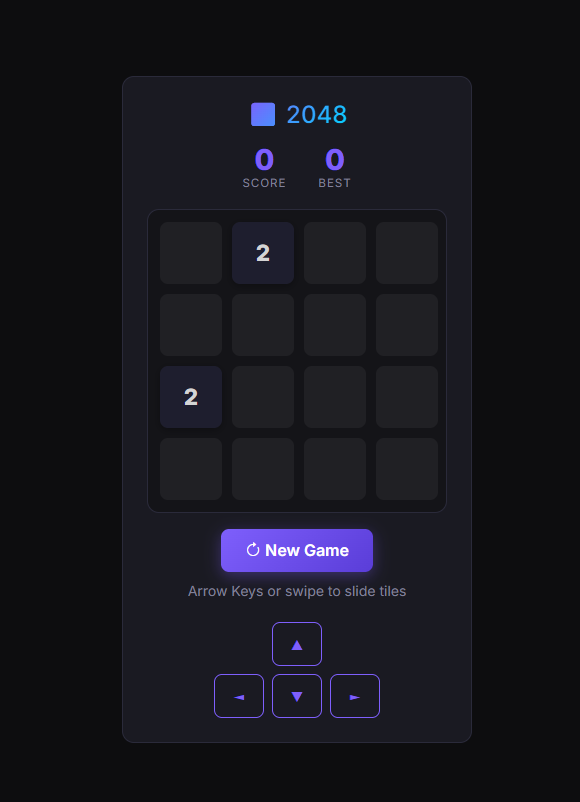
2048 is a single-player sliding tile puzzle originally built by Italian developer Gabriele Cirulli. The objective is to slide numbered tiles on a grid to combine them into a tile with the number 2048, though nothing stops you from continuing after that to chase 4096, 8192, or higher. Cirulli built the whole thing over a single weekend in March 2014 as a personal coding challenge and released it for free on GitHub (source) it wasn't designed to be a commercial product, it just went viral on its own.
The game plays out on a 4x4 grid. Every tile shows a power of 2 (2, 4, 8, 16, and so on), and your only actions are swiping or pressing arrow keys in one of four directions.
The Rules of 2048 (In Plain English)
The rules take about thirty seconds to learn:
- The board starts with two tiles, usually a 2 or a 4, placed randomly.
- You move in one of four directions — up, down, left, right using arrow keys (desktop) or swipes (mobile/touchscreen).
- Every tile slides as far as it can in the direction you chose, until it hits the wall or another tile.
- Two tiles with the same number merge into one when they collide, doubling the value (2+2=4, 4+4=8, 16+16=32, etc.).
- A new tile appears after every move — always a 2 or a 4 in a random empty square.
- You win when you create a 2048 tile. You lose when the board is full and no move is possible (no empty squares and no two adjacent tiles share a value).
That's the entire rule set. There's no timer, no opponent, no hidden mechanic. The difficulty comes entirely from the fact that every move you make also fills up your board which is exactly what trips up most beginners.
The #1 Beginner Mistake: Moving in All Four Directions
New players tend to swipe wherever there's open space, mixing up up/down/left/right moves without a plan. This feels natural, but it scrambles your board and scatters your big numbers across random corners, making merges harder to find as the grid fills up.
The fix is a strategy almost every strong 2048 player uses: pick one corner and never send your highest tile away from it.
The Corner Strategy (Beginner-Friendly)
- Choose a corner — bottom-left is the most popular choice, but any corner works as long as you stay consistent.
- Build your highest-value tile into that corner and keep it there. Never make a move that would push your biggest tile out of the corner.
- Use only three directions as your "main" moves. If your corner is bottom-left, you should almost never need to press "up" that's the move most likely to break your structure. Rely mainly on left, down, and right.
- Keep your row along the edge sorted from largest to smallest, moving away from the corner. This keeps big tiles locked in place while smaller tiles do the merging work in front of them.
- Don't chase random merges. A tempting merge in the middle of the board is often a trap if it forces you to move your anchor tile.
Once this becomes automatic, most of your losses will come from running out of "safe" moves late in the game rather than early chaos which is a much better problem to have.
Common Mistakes That Cause Early Losses
- Filling the board evenly instead of stacking. Spreading tiles out might feel organized, but it leaves you with no room to maneuver once the board is two-thirds full.
- Chasing the biggest number instead of the biggest merge. A move that merges three pairs of tiles is usually better than one that merges a single big pair.
- Panicking near the end. When the board looks full, resist the urge to make a random move just to "see what happens." Pause and check which single direction preserves your corner structure.
- Switching corners mid-game. Once you commit to a corner, changing your mind halfway through usually causes the collapse you were trying to avoid.
- Ignoring the "next tile" pattern. Since new tiles are always a 2 or a 4, you can often predict roughly how a row will fill and plan two moves ahead instead of one.
Quick Tips to Play Smarter
- Play slower than feels natural 2048 rewards patience over speed.
- Try to keep your two largest tiles adjacent to each other at all times.
- Treat every "up" move (if bottom-left is your corner) as a last resort, not a default.
- If you're stuck deciding between two moves, pick whichever one leaves more empty tiles open.
- Restart early if your board gets scrambled in the first ten moves it's faster than trying to save a bad start.
Want to put this into practice? Try the corner strategy on Gamezgrid's 2048 game and see how far you get past your usual score.
Frequently Asked Questions
Is there a trick to winning 2048 every time?
Not a guaranteed one 2048 has an element of randomness since new tiles are placed randomly after every move. But the corner strategy dramatically improves your odds and is the closest thing to a reliable method.
What is the best first move in 2048?
There's no single "correct" opening move, since the starting tiles are random. What matters more is picking your corner strategy early and sticking to it from move one.
Can you actually beat 2048, or does it go on forever?
You "win" by creating a 2048 tile, but the game doesn't force you to stop. You can continue playing after reaching 2048 to create even larger tiles, and many players keep going until the board fills up completely.
Why does my board fill up so fast?
This almost always means tiles are spreading out instead of stacking toward one corner. Revisit the corner strategy above it's the single biggest fix for this problem.
Is 2048 based on math or luck?
Both. The merging is pure math (powers of two), but tile placement after each move is random, so skill determines how well you manage that randomness rather than eliminating it.
Where did 2048 come from?
2048 was created by Gabriele Cirulli, an Italian web developer who built it in a single weekend in March 2014 and released it for free on GitHub. It was inspired by earlier games like Threes! and 1024!, and its simple, free, open-source format is a big part of why it spread so quickly. You can read more about the game's origin and mechanics on Wikipedia's 2048 entry and in Gabriele Cirulli's own account of the game's creation.
What's a good beginner score to aim for?
If you're new, aim to consistently reach 512 before pushing for 1024 or 2048. Jumping straight for the highest tile before your corner technique is solid usually backfires.
Keep the Streak Going
Once 2048 clicks, it's hard to stop opening it during a five-minute break. If you're looking for something to switch to when you need a change of pace, Gamezgrid also has quick, no-download picks like Snake, Minesweeper, and Connect Four all built for exactly the kind of short session 2048 fans already love.


